# Regional capacity and managed inference cost floors
DIMAGGI AI technical paper | 4 October 2026
**Evidence boundary.** Study source `5c4c8434dd0f92556aed46b4ebcda0c11ae468de`. Results are deterministic synthetic planning outputs. Public physical specifications and third-party benchmark observations retain their separate original scope. Model QA does not establish independent technical acceptance, legal compliance, production availability or realized commercial outcomes.
## Abstract
An inference service needs a compatible workload, eligible locations, capacity
available at peak demand, recovery inventory and a reconciled cost envelope.
We examine the existing offline regional placement, pricing and paired-offer
models using their frozen synthetic examples. The regional screen rejects a
policy-ineligible pool even when it has spare capacity. The paired offer costs
two whole accelerator units at each of the primary and standby pools. A separate
capped-use example produces a $4,717.68 stress cost and $0.006419 request floor,
but requires 749,955 billable requests to recover that period cost under its
credit assumption. These are conditional arithmetic findings, not observed
customer economics. Public aggregate inference observations do not supply the
phase-specific calibration needed by the price model. No result establishes
legal compliance, available supplier capacity, profitable operation or an SLA.
## Research question and contribution
The question is whether the existing planning interfaces retain the distinctions
between policy eligibility, whole-replica peak reserve, period costs and request
billing when composing a proposed regional service. This is a deterministic
interface and accounting study, not a vendor comparison or optimal-placement
study. It complements the [capacity and lifecycle paper](https://dimaggi.ai/research/capacity-lifecycle)
and reuses the existing network, scheduling, cooling and reliability owners. No owner model is reimplemented here.
The hypotheses are deliberately narrow: spare pool capacity cannot override
declared locality rules; average period utilization cannot replace a peak reserve;
and a feasible arithmetic quote cannot prove either demand or operational
qualification. Refusal cases and the persistence of cost at low sales are part
of the result, rather than discarded exceptions.
## Methods and reproducibility
The [reproduction appendix](https://dimaggi.ai/assets/research/evidence/2026-10-04/README.md) records the source pin,
environment, commands and artifact hashes. The wrapper runs the three existing
CLI examples and the existing public-data analysis without changing their inputs
or engineering code. The [manifest](https://dimaggi.ai/assets/research/evidence/2026-10-04/manifest.json)
checks every exported model, fixture and test file against the candidate; private coordination documents are excluded from the public bundle. There is no stochastic sampling or seed. Results are exact
under the declared inputs; there is no empirical population from which to infer
confidence intervals. The existing 186-test suite and Go race tests were rerun;
their success establishes tested implementation behavior only.
| Fixture | Purpose and unit | Material assumptions |
| --- | --- | --- |
| [placement-example.json](https://dimaggi.ai/assets/research/evidence/2026-10-04/dimaggi-planning-evidence-5c4c843.zip) | Screen one added workload; requests/s per complete replica | Synthetic DE/US pools, 80 peak requests/s, 100 good requests/s per replica, 0.7 utilization ceiling; supplied latency, age and failure-domain labels |
| [pricing-example.json](https://dimaggi.ai/assets/research/evidence/2026-10-04/dimaggi-planning-evidence-5c4c843.zip) | Capped-use period cost; USD per bounded request | 1,000,000 planned requests over 720 hours; 2,048 input and at most 512 output tokens; at most two attempts; synthetic throughput and rates; one primary plus one failover accelerator |
| [offer-example.json](https://dimaggi.ai/assets/research/evidence/2026-10-04/dimaggi-planning-evidence-5c4c843.zip) | Bind peak reserve to a predictable quote | Different synthetic phase throughput and minimum allocation; one accelerator per whole replica, two allocated at each pool |
| [public-data provenance](https://dimaggi.ai/assets/research/evidence/2026-10-04/dimaggi-planning-evidence-5c4c843.zip) | Parse pinned third-party observations with source and unit boundaries | Public benchmark observations remain whole-system, scenario-specific observations; geography and operational sensitivity inputs remain synthetic |
The standalone price fixture and paired-offer fixture differ in performance
inputs and service class. They are not a controlled comparison of reservation
policies. In particular, $4,717.68 is not the cost of the paired 2+2 offer.
For peak demand `P`, resident demand `R`, declared replica goodput `g` and
utilization ceiling `u`, the placement screen requires
`ceil((P + R)/(g*u))` total replicas. The paired offer separately reserves whole
resident replicas and costs the incoming workload's dedicated reserve. It uses
the larger of the goodput-based incoming reserve and a serialized uncached
prefill/decode demand bound, multiplied by the maximum attempt count. Standby
must carry the full incoming peak after resident reservation. Rounding occurs
at whole-replica boundaries. Supplied independence labels must differ in each
required dimension, but labels do not measure correlated failure probability.
The price model adds prefill and decode seconds per attempt, then computes
`busy_hours = requests * attempts * service_seconds / 3600`. Primary quantity
is at least the declared minimum and otherwise the ceiling of busy hours divided
by `period_hours * utilization * (1 - headroom)`. Failover quantity is a ceiling
of the chosen fraction of primary quantity. The expected case uses declared
cache hits and expected extra attempts. Both cases use maximum output tokens;
stress uses cache misses and maximum attempts. These serialized, linear demand assumptions do not predict
batch overlap, memory fit, queueing, time to first token or tail latency.
Cost includes all provisioned primary and failover hours, disjoint compute,
energy/cooling and interconnect components, storage, network usage, platform,
observability, support, licensing and the stated risk reserve. USD has no inferred
FX or tax conversion; a GB is 10^9 bytes. The 720-hour price period is distinct
from the lifecycle model's actual calendar-month hours. Already included energy
or platform components must be zeroed with supporting attribution, rather than
charged twice. Integer ceilings use rational arithmetic; money uses the model's
explicit Decimal context. Unit prices round upward to microdollars and invoices
upward to cents.
## Findings
### RI 01 Regional eligibility remains a policy screen
The [placement result](https://dimaggi.ai/assets/research/evidence/2026-10-04/frozen/placement-result.json) retains
the two DE-labelled candidates and rejects `example-us-c` for all eight declared
country planes: processing, storage, backup, telemetry, control, keys, operators
and transit. The rejected pool has a modeled 700 requests/s of warm spillover,
so unused modeled capacity does not override those inputs. The result says
`candidate_for_review`, with `production_qualified` and `execution_authority`
false. This is an application of caller policy to caller-supplied data, not a
legal conclusion or authenticated regional inventory. Google Cloud's resource
location documentation also distinguishes creation restrictions from data
storage commitments; it is related scope guidance, not validation of this model.
[Google Cloud](https://docs.cloud.google.com/organization-policy/restrict-locations)
### RI 02 Whole peak reserves remain in the paired quote
The [paired-offer result](https://dimaggi.ai/assets/research/evidence/2026-10-04/frozen/offer-result.json) requires
two accelerator units at the primary pool and two at standby. Available capacity
after resident reservation is also two at each. Its stress cost is $8,756.88,
fixed unit floor $0.011915 and predictable planned commitment $11,915.00. These
numbers describe the distinct paired synthetic fixture. A real eight-accelerator
replica would require whole groups of eight and matching calibration; the example
does not establish that one device can serve an actual workload. The adapter
does not allocate live capacity, and `tool_guard_evaluated` is false.
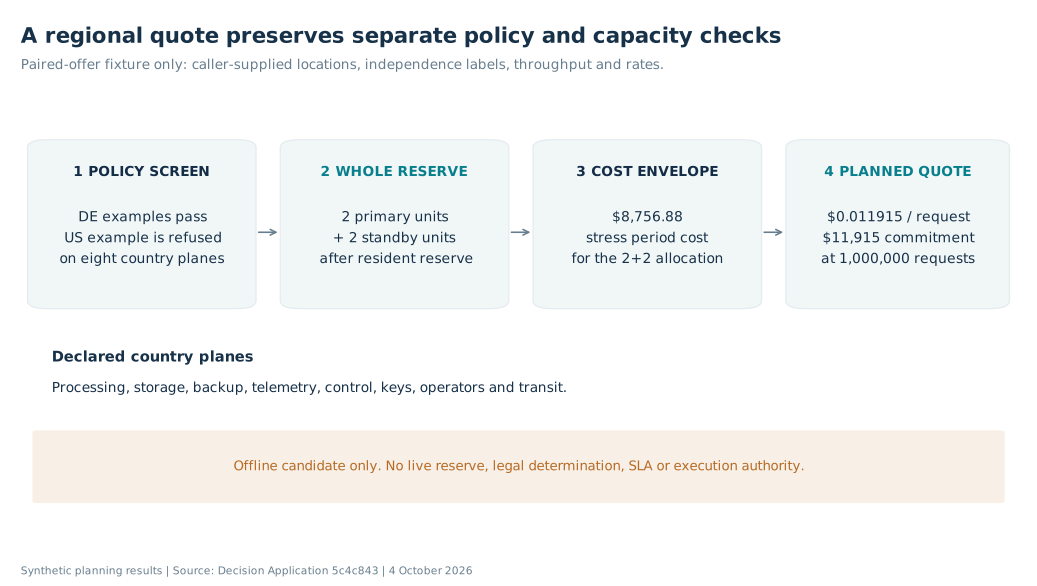
Figure 1. The paired-offer fixture keeps declared policy eligibility, peak reserve, period cost and customer quote as separate checks. The standby allocation can carry the incoming peak under supplied linear capacity assumptions. Differing labels are not evidence of real failure independence or lawful processing. [Figure data (CSV)](https://dimaggi.ai/assets/research/regional-inference/regional-constraint-flow.csv).
### RI 03 A cost floor retains demand risk
The existing pricing interface proposes
predictable commitment, capped flexible usage and interruptible usage, each with
a fixed customer rate for a bounded envelope. Payment class does not itself
qualify recovery or availability; those remain separate capacity and evidence
requirements. These are proposed classes, not accepted products.
The separate [capped-use result](https://dimaggi.ai/assets/research/evidence/2026-10-04/frozen/pricing-result.json)
has stress cost $4,717.68, unit floor $0.006419 and a $6,419.00 planned invoice
at one million requests. Its full period cost divided by the per-request rate
after the 2% reserved credit fraction requires 749,955 billable requests, rounded
up. That is a conditional cost-recovery threshold, not a sales forecast. Fixed
provisioned capacity remains costly if fewer requests arrive; the planned
allowance and maximum affordable requests do not establish demand. Maximum
contractual credits in this fixture equal the whole planned invoice, leaving
zero net revenue in that extreme. The expected credit reserve does not fund that
maximum liability.
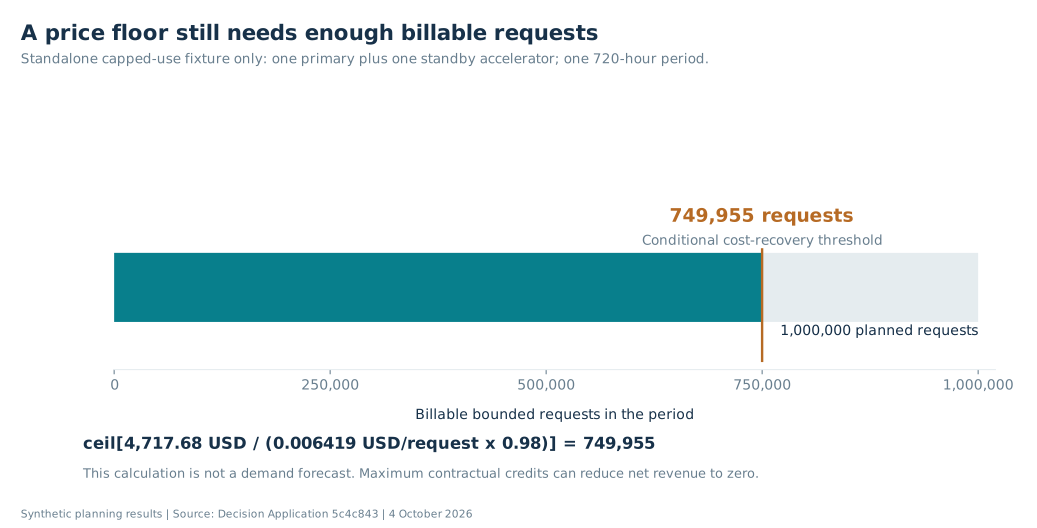
Figure 2. The threshold retains the full stress period cost and assumes the fixed bounded-request rate with 2% reserved credits. A variable-cost volume experiment would be required for a broader profitability curve. The maximum contractual credit exposure is larger than the expected reserve. [Figure data (CSV)](https://dimaggi.ai/assets/research/regional-inference/request-cost-threshold.csv).
### RI 04 Margin and markup have different denominators
For cost `C` already including the risk reserve, target net gross margin `m`
and reserved credit fraction `c`, the pre-rounding invoice floor is
`C/((1-c)*(1-m))`. Realized modeled margin is `(net_revenue-C)/net_revenue`;
invoice markup is `(invoice-C)/C`. The capped-use fixture reports about 25.005%
net gross margin using $6,290.62 revenue after reserved credits as its denominator,
and about 36.063% invoice markup using $4,717.68 cost as its denominator.
At the maximum contractual credit exposure, net revenue is zero and margin is
undefined; it is not a finite negative percentage. Both reported percentages
describe the same modeled planned volume and reserved-credit assumption. Neither measures actual
profit, demand, credit eligibility or an accepted price. See the exact Decimal
outputs in the [price artifact](https://dimaggi.ai/assets/research/evidence/2026-10-04/frozen/pricing-result.json).
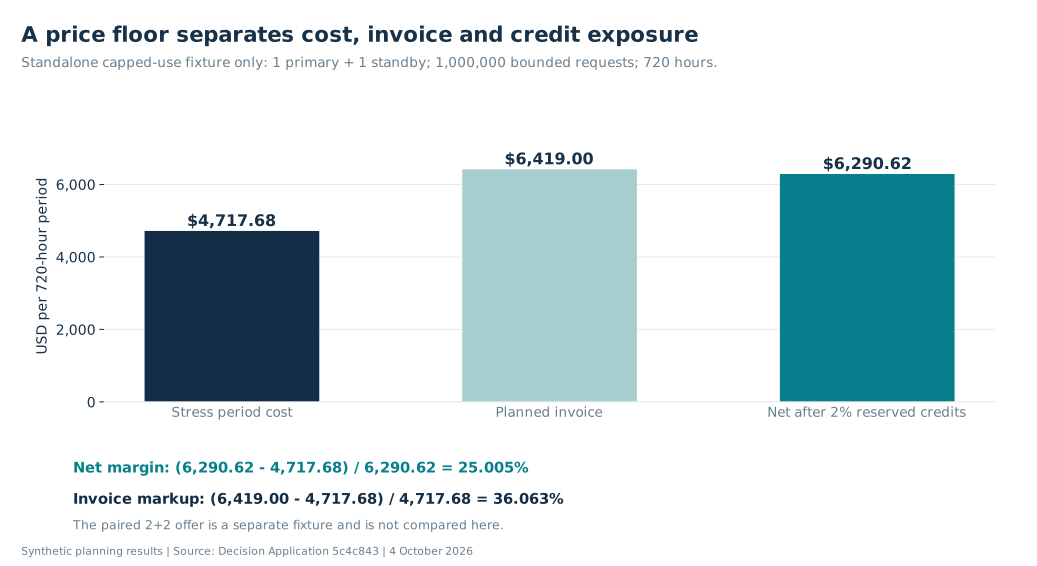
Figure 3. The standalone cost floor retains provisioned primary and standby capacity over the full 720-hour period. The margin denominator is net revenue after reserved credits; the markup denominator is cost. These are planned-volume calculations using synthetic rates, not observed profit or market prices. The 2+2 offer is a distinct fixture documented separately. [Figure data (CSV)](https://dimaggi.ai/assets/research/regional-inference/standalone-cost-floor.csv).
### RI 05 The local budget invariant has an operating boundary
The existing `BudgetBook` requires spent plus held money to remain within its
cap and refuses settlement above a reservation. Tests exercise concurrent
threads, replay and excessive settlement. It is process-local, loses state on
restart and does not cancel supplier work. This supports a prototype invariant,
not a durable production spending cap. A multi-worker admission ledger, bounded
in-flight liability and billing reconciliation require additional implementation
and evidence. AWS documents that budget notifications can lag incurred charges;
this motivates the distinction between monitoring and admission control without
establishing a guarantee for either system.
[Source and tests](https://dimaggi.ai/assets/research/evidence/2026-10-04/dimaggi-planning-evidence-5c4c843.zip),
[AWS Budgets](https://docs.aws.amazon.com/cost-management/latest/userguide/budgets-managing-costs.html)
### RI 06 Aggregate public observations cannot fill missing phase calibration
The [frozen refusal record](https://dimaggi.ai/assets/research/evidence/2026-10-04/frozen/calibration-refusals.json)
shows that `pricing_calibration` refuses both selected AMD MI355X and NVIDIA B300
inference records because they lack separate prefill, cached-prefill and decode
measurements.
The [public-data result](https://dimaggi.ai/assets/research/evidence/2026-10-04/frozen/public-data-result.json)
preserves original observation scope and synthetic placement sensitivity labels.
No GPU was run locally. Whole-system benchmark throughput cannot be divided into
per-device phase rates without a justified scaling model. Hardware specification
fixtures in the lifecycle paper are a further, separate evidence class.
MLPerf's workload, quality and scenario conditions inform future measurement
design; parsing its results does not qualify this application or its prices.
[MLPerf Inference documentation](https://docs.mlcommons.org/inference/)
## Lifecycle and governance interfaces
The existing lifecycle bridge permits a fully attributed, committed bundle with
matched hardware, profile, calendar and calibration identity. It distributes
bundle cost over primary device-hours while retaining the paid recovery scope;
it refuses duplicate cost components and unsupported workload conversions.
This connects accounting interfaces, not verified hardware performance. The
separate lifecycle orchestrator invokes the real Tool Guard v0.3.0 evaluator for
offline policy decisions. Allowed planning and escalated procurement/network/
retirement proposals do not authorize effects. Execution and verification remain outside this planning model. A hash binds content; it does not authenticate its issuer or
record a review. See [contracts](https://dimaggi.ai/assets/research/evidence/2026-10-04/dimaggi-planning-evidence-5c4c843.zip)
in the public source bundle.
## Additional experiments required
| Question not answered here | Necessary design before a stronger claim |
| --- | --- |
| What service can one actual replica sustain? | Matched model, precision, prompt/output distribution, cache state and quality; measured phase rates, memory fit and client-visible TTFT/TPOT under stepped load; repetitions and uncertainty |
| Does regional recovery preserve the service? | Authorized site evidence and correlated dependency failures; resident peak load, routing/state restoration and failback; good/total request denominator including admitted failures and specified cap refusals |
| Does a cap survive operational faults? | Durable concurrent reservation, crash/restart, duplicated and delayed receipts, supplier cancellation failure, bounded retry/fan-out and reconciliation against final invoices |
| Can the proposed price recover costs? | Dated supplier contracts with units and inclusion rules; measured operations/support cost, demand distribution, credits and sensitivity to unsold reserve; separate commercial approval |
| Do locality inputs correspond to actual processing? | Workload-specific approved policy plus authenticated storage/access/transit and subprocessor evidence; separate legal assessment, not an experiment that can prove lawfulness |
An availability SLI should state good events, total eligible events, window and
exclusions before a target is considered. Google SRE provides a useful method
for that definition; this study contains no production request population.
[Implementing SLOs](https://sre.google/workbook/implementing-slos/)
## Evidence checklist
| Findings | Public evidence | Interpretation check |
| --- | --- | --- |
| RI-01 | [Regional placement result](https://dimaggi.ai/assets/research/evidence/2026-10-04/frozen/placement-result.json) | Policy is supplied; location and legal status are not attested. |
| RI-02 | [Paired-offer result](https://dimaggi.ai/assets/research/evidence/2026-10-04/frozen/offer-result.json) | Distinct 2+2 fixture; no comparison of policy benefits against the 1+1 fixture. |
| RI-03, RI-04 | [Standalone price result](https://dimaggi.ai/assets/research/evidence/2026-10-04/frozen/pricing-result.json) | Preserve 720 hours, one million planned bounded requests, credit reserve and maximum liability. |
| RI-05 | Byte-exact source tests and [reproduction instructions](https://dimaggi.ai/assets/research/evidence/2026-10-04/README.md) | Process-local budget invariant; no durable production spending cap. |
| RI-06 | [Calibration refusals](https://dimaggi.ai/assets/research/evidence/2026-10-04/frozen/calibration-refusals.json) and [public-data analysis](https://dimaggi.ai/assets/research/evidence/2026-10-04/frozen/public-data-result.json) | Whole-system observations cannot fill absent phase calibration. |
## Reproducibility appendix
The [public evidence bundle](https://dimaggi.ai/assets/research/evidence/2026-10-04/dimaggi-planning-evidence-5c4c843.zip) contains the permitted byte-exact model source, tests, fixtures, frozen outputs and a packaging-only reproduction wrapper. The [manifest](https://dimaggi.ai/assets/research/evidence/2026-10-04/manifest.json) binds the exported files to source `5c4c8434dd0f92556aed46b4ebcda0c11ae468de`. [Reproduction instructions](https://dimaggi.ai/assets/research/evidence/2026-10-04/README.md) describe the environment, source verification, model execution and test commands. The cooling owner is pinned to `735d8eb8196b70aa6beea759bc3c9470ce286a74`. No hardware or cloud workload is executed.
The [clean-extraction validation receipt](https://dimaggi.ai/assets/research/evidence/2026-10-04/qa/extracted-validation.json) records 186 passing Python tests and successful Go race checks. The separate [reproduction receipt](https://dimaggi.ai/assets/research/evidence/2026-10-04/qa/extracted-reproduction-receipt.json) records equality for all nine scenarios, the 60-month plan, four CLI outputs and two calibration refusals. These receipts are implementation QA.
Unpack the archive into a new folder, read its README, and first run `python3 reproduce.py --verify-only`. Full replay requires Python 3.12, Go 1.26.1 and the named cooling-owner checkout; use the exact commands in the bundle. The original scenario outputs and their negative results remain unchanged. Variable elapsed-time metadata is excluded from numerical equality; it is not a new performance benchmark.
Source links in the body that target the archive refer to the path named in the link or adjoining text. Key files include `service_planning/lifecycle/experiments.py`, `service_planning/lifecycle/docs/CONTRACT.md`, `service_planning/lifecycle/docs/SOURCES.md`, the JSON examples, the pricing/placement/offer modules and their tests. The public bundle omits private coordination documents and does not expose the owning repository's full history.
## References
1. [Google Cloud: resource-location restrictions](https://docs.cloud.google.com/organization-policy/restrict-locations). Location-policy scope does not establish lawful processing.
2. [AWS Budgets: managing costs](https://docs.aws.amazon.com/cost-management/latest/userguide/budgets-managing-costs.html). Budget notifications and admission control have different operating boundaries.
3. [MLPerf Inference documentation](https://docs.mlcommons.org/inference/). Workload, quality and scenario conditions must accompany observations.
4. [Google SRE Workbook: implementing SLOs](https://sre.google/workbook/implementing-slos/). Define good events, eligible events, window and exclusions before applying a service objective.