The old bargain of enterprise governance was simple. Let the system operate, collect evidence afterward, and rely on audit, review, and remediation to close the loop. That bargain was always imperfect, but it was workable when the unit of action was a human submitting a change, approving an exception, or opening a ticket.
Agents break that bargain.
An AI agent does not wait for a monthly access review. It does not pause before the fifth API call in a chain to ask whether the first four changed the risk profile. It can read, reason, invoke tools, mutate records, create tickets, trigger workflows, and hand off context to another agent in the time a human reviewer is still scanning the request.
Governance is no longer primarily a documentation problem. It is a latency-budget problem.
The implication is direct. Every tool call is a decision point. If the policy decision cannot fit inside the execution path, the enterprise is left with two bad choices. Slow the agent down until it no longer delivers the speed advantage that justified deployment. Or let the agent run and convert governance into after-the-fact forensics.
That is not governance. It is a postmortem archive.
This is the tool-boundary thesis. When intent becomes action at machine speed, enforcement has to live where the action lands.
The 50x speed gap is now load-bearing
Audit asks what happened. Enforcement decides what is allowed to happen next. That distinction was a comfortable abstraction when both happened at human speed. Once the actor is an agent firing thirty to fifty tool calls in a second, the distinction becomes architectural.
Most enterprise governance systems were designed around human-scale operations. Access reviews, exception workflows, compliance attestations, and approval queues assume that the request itself has a natural dwell time. Someone asks. Someone reviews. Someone approves. Someone acts.
Agentic systems invert that order. The model decides, calls a tool, observes the result, revises the plan, and calls the next tool without a human-visible pause. That does not mean every agent is fully autonomous. It means the control plane has to be designed for the speed of execution, not the speed of review.
The numbers that should be informing your next architecture review:
- Only 3% of organizations operate automated, machine-speed controls governing AI agent behavior. 67% still rely on static credentials, and high reliance on static credentials correlates with incident rates twenty percentage points higher than low reliance. ([Teleport, 2026 State of AI Infrastructure Security][1])
- AI systems with excessive permissions show a 4.5x higher security incident rate than systems running under least-privilege controls. ([Teleport][1])
- The average enterprise carries more than 250,000 non-human identities. 97% are over-privileged beyond their function. 71% are not rotated within recommended timeframes. ([Protego, 2026 NHI Security Crisis Report][2]) Machine-to-human identity ratios in production environments now run between 100:1 and 500:1.
- SpyCloud's 2026 Identity Exposure Report recaptured 18.1 million exposed API keys and tokens in 2025. 6.2 million were tied directly to AI tools. ([SpyCloud][3])
The conclusion is operational, not theoretical. Once agents are actors in the environment, identity and access governance must operate at the same granularity as agent action. Static credentials, broad scopes, and retrospective review are a poor fit for systems that can chain actions across tools at machine speed.
The Governance Latency Budget
In high-frequency trading, every microsecond on the wire is accounted for. In hyperscale networking, latency budgets are negotiated across the path before a single packet ships. The same rigor now applies to agentic governance.
The Governance Latency Budget (GLB) is the maximum time a policy check can take without degrading the utility of the agent.
The math is simple. For a target orchestration of N tool calls with an acceptable governance overhead of T milliseconds total, the per-call governance budget is T divided by N. For a fifty-call chain with 500ms acceptable overhead, the per-call budget is 10ms. For a performance-sensitive fifty-call chain with 50ms acceptable overhead, the per-call budget is 1ms.
Most enterprises have never calculated this number. That absence is the thing senior architects should be most alarmed by, because it means governance is being designed without a performance contract. A control that has no performance contract has no honest path to production.
The 0.1ms floor and what it demands
On April 2, 2026, Microsoft shipped its open-source Agent Governance Toolkit with a stated p99 performance target of less than 0.1ms per policy decision. The project's GitHub performance section states that governance adds less than 0.1ms per action, roughly ten thousand times faster than an LLM API call, with policy enforcement listed at 0.091ms. ([Microsoft Open Source Blog][4]; [GitHub: microsoft/agent-governance-toolkit][5])
That number resets the conversation.
The right question is no longer whether governance is too slow in principle. The right question is whether a given governance design fits the action path. Three implications follow directly:
Policy must be pre-compiled. Evaluating natural-language rules at execution time is too slow. Policies need to compile into decision tables, binary rule engines, or WebAssembly modules that execute in microsecond ranges.
Policy data must be local. If enforcement requires a network call to a central policy server on every tool invocation, the budget blows immediately. The Policy Decision Point must be co-located with the agent runtime, either as a sidecar, an embedded library, or an in-process module.
Policy updates must be asynchronous. New rules propagate to enforcement points in the background. The evaluation path itself never blocks on a policy fetch.
This architecture, a co-located PDP evaluating pre-compiled rules at the tool boundary, is the standard pattern emerging across Microsoft's toolkit, Oracle's Agent Runtime Controller, and Okta's identity-scoped enforcement work. Three independent engineering organizations, each solving for the same constraint, arrived at the same layer. That convergence is informative.
The 42-millisecond contagion
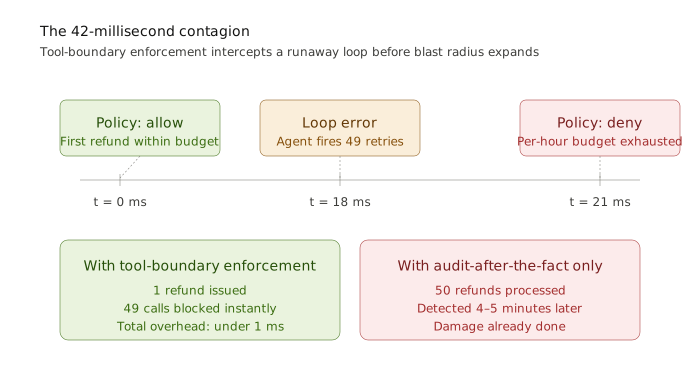
Consider a production scenario. An autonomous Customer Success Agent has write access to a CRM and a billing system through an MCP gateway.
10:14:00.000 — A high-value customer sends a complex email about a billing discrepancy.
10:14:00.450 — The agent parses the intent and decides to issue a refund and apply a loyalty credit.
10:14:00.455 — The agent initiates a tool call to the billing API to issue the refund.
10:14:00.456 — The tool-boundary enforcement point intercepts the call. The policy engine has under 0.1ms to verify the agent is authorized to refund this amount for this customer tier.
10:14:00.456.1 — The policy engine confirms the refund is within the agent's per-hour budget. The call proceeds.
10:14:00.468 — The billing API confirms the refund.
10:14:00.470 — The agent, following a logical loop error, attempts to execute the same refund tool call fifty more times.
10:14:00.471 — The enforcement point detects the rapid-fire pattern. The agent's per-hour budget is now exhausted. The remaining forty-nine calls are blocked instantly.
Total governance overhead across the chain: under one millisecond.
If the same organization had relied on audit-after-the-fact governance, the agent would have processed the full recursive loop before any human alert reached the security operations center. The first email from a finance lead would have arrived four to five minutes later, asking why a single customer just received fifty identical refunds.
The 42-millisecond contagion is not hypothetical. Variants of this pattern have been documented across multiple production deployments in 2025 and 2026. The failure is not in the model. The failure is that the model's mistake had no constraint between intent and consequence.
The Enforcement Velocity Scale
To diagnose where your organization sits today, classify your current enforcement methodology against five levels.
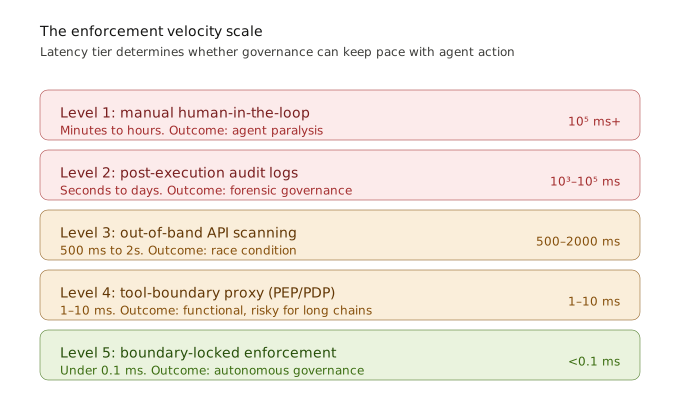
Level 1: Manual human-in-the-loop. Review takes minutes to hours. Outcome: agent paralysis. The agent is no faster than a human employee, defeating the deployment economics.
Level 2: Post-execution audit logs. Review takes seconds to days. Outcome: forensic governance. You will know exactly why you were fired, after the event.
Level 3: Out-of-band API scanning. Review takes 500ms to two seconds. Outcome: race condition. The agent typically completes the task before the scanner flags it.
Level 4: Tool-boundary proxy with PEP and PDP, latency 1ms to 10ms. Outcome: functional governance. Safe for low-frequency agents. Risky for high-chain agents where the per-call budget collapses.
Level 5: Boundary-locked enforcement, latency under 0.1ms. Outcome: autonomous governance. The only level that supports fifty-plus tool-chain agents at production speed.
Most enterprises sit at Level 2. They believe their security operations center can handle agents the same way it handled API calls in 2022. It cannot.
The diagnostic that operationalizes the EVS classification is six steps:
- Measure your current governance latency. Time the interval between an agent selecting a tool call and that call being evaluated against organizational policy. If the answer is "we evaluate in batch after execution," the latency is effectively infinite.
- Map your enforcement placement. List every point in your agent execution path where policy is currently evaluated. Classify each by three requirements: sub-millisecond latency, semantic visibility, synchronous block authority.
- Calculate your latency budget. Use the T/N formula. Write the number down. If you cannot, you do not have a budget.
- Evaluate your PDP placement. Is the Policy Decision Point co-located with the agent runtime? Does it evaluate pre-compiled rules? Does it require a network call on the hot path?
- Assess your credential architecture. What percentage of your agent tool calls use standing credentials versus just-in-time scoped tokens? The 97% over-privilege rate across enterprise NHIs is the baseline you are improving against.
- Verify your compliance evidence path. Does your enforcement architecture produce structured decision records as a natural byproduct, or does logging require a separate, post-hoc process?
Organizations that cannot answer steps one through three with specific numbers have not yet engaged with governance as a latency problem. They are still operating in the documentation paradigm.
MCP is necessary but not sufficient
Model Context Protocol servers and tool gateways have become the dominant abstraction for agent-to-tool communication. They are a natural candidate for governance insertion. Early implementations reveal a structural gap.
Public MCP server analysis suggests roughly 53% rely on long-lived static secrets as their primary authentication mechanism. ([CData, MCP Server Vulnerability Analysis][6]) This is not a minor hygiene issue. Once those secrets enter criminal underground markets, every agent connected to that MCP surface inherits the breach blast radius.
MCP gateways offer an inline enforcement point, but their visibility is limited to what the protocol surfaces. If the protocol does not carry sufficient context about the agent's reasoning chain or the user's delegated permissions, the gateway enforces in a partial-information environment.
The architectural correction: treat MCP gateways as one enforcement surface within a broader tool-boundary policy architecture, not as the complete solution. The PDP needs context the gateway alone cannot provide. The agent's cumulative session state. The originating user's permission scope. The organizational policy corpus. These have to be composed at evaluation time from multiple sources, all within the latency budget.
The pattern is older than agents. Separate the policy enforcement point from the policy decision point. The enforcement point sits inline. The decision point evaluates. The audit trail records. For agents, this pattern needs to adapt to tool calls, delegated identity, runtime context, and machine-speed execution.
The August 2, 2026 compliance window
Regulation is adding urgency, but the underlying problem is architectural.
EU AI Act Article 12 requires high-risk AI systems to technically allow automatic recording of events over the system's lifetime, with logging capabilities supporting traceability, post-market monitoring, and operational oversight. ([EU AI Act, Article 12][7]) Article 99 sets penalties up to €35 million or 7% of worldwide annual turnover for prohibited practices, and €15 million or 3% for several other obligation failures. ([EU AI Act, Article 99][8])
The implementation timeline remains politically active. The European Commission's Digital Omnibus proposal sought to defer certain high-risk compliance deadlines from August 2, 2026 to December 2, 2027. The second political trilogue on April 28, 2026 ended without agreement. The next session is scheduled for May 13, 2026. If the Omnibus is not formally adopted before August 2, 2026, the original timeline applies as written. ([DLA Piper, Digital AI Omnibus update][9]; [Reuters][10])
The point is not to litigate the final date. The point is that compliance evidence has to be produced by systems, not by aspiration. If an agent invokes tools, changes state, or influences regulated decisions, the enterprise needs a record of what happened, why it was allowed, which policy applied, which identity acted, what context was used, and whether the action stayed within scope.
A log that says a request occurred is not enough. A defensible audit trail connects identity, intent, policy, decision, tool, payload class, result, and exception handling. In agentic systems, that evidence is easiest to capture at the same point where enforcement occurs.
The compliance clock reinforces the latency argument. If logs are generated after the fact, detached from enforcement, they help reconstruct failure. If logs are generated as part of the policy decision itself, they become evidence of control.
What this means in the next 90 days
Three actions cannot wait for the next planning cycle.
Instrument your tool boundary now. Even before policy logic is complete, capture structured telemetry at every agent-to-tool junction. Function name, parameters, caller identity, timestamp, session context. This telemetry is both the foundation for future enforcement and the raw material for Article 12 compliance.
Benchmark your governance latency against the 0.1ms floor. If your current policy evaluation takes longer than 1ms per call, you are outside the performance envelope leading vendor implementations have established. Investigate pre-compiled policy engines, co-located PDPs, and cached credential issuance.
Eliminate standing credentials from agent tool access. Every agent tool call should authenticate with a scoped, time-bounded credential tied to the specific action being performed. The 4.5x incident multiplier on over-privileged agents, paired with the 100:1 to 500:1 machine-to-human identity ratio in enterprise environments, makes standing access the single largest blast-radius amplifier in your agent architecture.
Two organizational shifts make these technical actions stick.
The compliance auditor role becomes the latency profiler. The job is not to certify documentation. It is to audit the governance latency budget and ensure policy checks fit inside the per-call envelope.
The permission janitor role becomes the policy-as-code engineer. Manual access tickets become machine-readable, binary policy objects evaluated at the tool boundary. A governance rule that lives only in a PDF will not constrain a tool call.
The latency budget is the new governance primitive
The enterprise AI conversation has spent two years debating whether models can be trusted. That question matters, but it is not sufficient for production agents. The better operating question is: what is this agent allowed to do, through which tools, under which policy, with what evidence, and at what latency.
Audit-after-the-fact cannot answer that question in time. Human review cannot scale to every tool call. Static credentials cannot express dynamic intent. Prompt guardrails cannot serve as security boundaries. Observability cannot block an action that has already completed.
The tool boundary can.
It is the point where intent becomes action, where policy can still change the outcome, and where evidence can be generated before governance collapses into investigation. At DIMAGGI AI, we describe this pattern as a runtime policy firewall for agents. Intercept the tool call. Evaluate it against policy. Decide before execution. Commit the decision to an audit chain. That is one implementation of the broader architectural shift.
The larger point is not vendor-specific. Governance has acquired a latency budget. The organizations that understand this will design agent systems with enforcement in the execution path. The organizations that do not will keep producing better audit trails for failures they were never architected to prevent.
I posit that the phrase your next standup might need is not "how do we govern our agents." It is "what is our governance latency budget, and does our enforcement architecture fit inside it."
[1]: https://goteleport.com/about/newsroom/press-releases/2026-state-of-ai-in-enterprise-security-report/ "2026 State of AI in Enterprise Infrastructure Security Report, Teleport"
[2]: https://protego.me/blog/non-human-identities-nhi-ai-agent-security-2026 "Non-Human Identities (NHI): The Hidden Security Crisis Powering AI Agent Attacks in 2026"
[3]: https://www.cybersecurity-insiders.com/spyclouds-2026-identity-exposure-report-reveals-explosion-of-non-human-identity-theft/ "SpyCloud's 2026 Identity Exposure Report"
[4]: https://opensource.microsoft.com/blog/2026/04/02/introducing-the-agent-governance-toolkit-open-source-runtime-security-for-ai-agents/ "Introducing the Agent Governance Toolkit, Microsoft Open Source Blog, April 2, 2026"
[5]: https://github.com/microsoft/agent-governance-toolkit "microsoft/agent-governance-toolkit, GitHub"
[6]: https://www.cdata.com/blog/mitigate-mcp-server-vulnerabilities "Mitigate MCP Server Vulnerabilities Before They're Exploited, CData"
[7]: https://artificialintelligenceact.eu/article/12/ "Article 12, Record-keeping, EU AI Act"
[8]: https://artificialintelligenceact.eu/article/99/ "Article 99, Penalties, EU AI Act"
[9]: https://knowledge.dlapiper.com/dlapiperknowledge/globalemploymentlatestdevelopments/2026/The-Digital-AI-Omnibus-Proposed-deferral-of-high-risk-AI-obligations-under-the-AI-Act "The Digital AI Omnibus, DLA Piper, April 2026"
[10]: https://www.reuters.com/sustainability/boards-policy-regulation/eu-countries-lawmakers-fail-reach-deal-watered-down-ai-rules-2026-04-29/ "EU countries, lawmakers fail to reach deal on watered-down AI rules, Reuters, April 29, 2026"