The intelligence layer for autonomous network infrastructure is the real competitive advantage, its hard-to-copy core is verified ground truth, and the operators who say the least about it are the ones already building it.
The contest in autonomous infrastructure is being decided in a layer most people are not looking at, and the leaders are not announcing it.
Capital markets can see fiber, data centers, switching systems, model providers, and automation platforms. What they cannot easily price is the private layer between the physical network and the systems permitted to act on it: a current, verified account of what the network actually is, how it behaves, and which actions remain safe. The sensing components of that layer are increasingly published and buyable. The accumulated corpus and the loop that produces it are not.
1. The moat is not the assets, and it is not the models
The most durable advantage in autonomous network infrastructure is neither the asset base nor the model layer. It is the verified account of what the physical network actually is and is doing.
Physical infrastructure can be deeply defensible. Rights of way, landing access, power availability, construction lead times, operating expertise, and installed capacity all create real barriers. The point is not that assets lack strategic value. The point is that assets are visible, financeable, and, over a long enough horizon, reproducible by sufficiently committed capital.
The model layer is more exposed still. Foundation models, orchestration frameworks, policy systems, and control abstractions improve quickly, but the relevant capabilities are increasingly available through vendors, open research, licensing, and talent mobility. A company may hold a temporary integration lead. Much of the model and tooling stack can still be observed, benchmarked, purchased, or reconstructed.
The defensible middle behaves differently.
| Layer | What competitors can access | What remains hard to reproduce |
|---|---|---|
| Physical assets | Equipment, construction capacity, financing, vendors, published architecture patterns | Time, rights, operating execution, installed position |
| Models and automation | Commercial models, open research, orchestration tools, control software | Temporary integration advantage, domain tuning |
| Verified intelligence layer | Published sensing methods and individual tools | A current corpus of observed physical state, its history and provenance, and the loop that keeps verifying it |
The companion paper, The Infrastructure Schism: Authority Is Not Truth, establishes the distinction this argument rests on: controlling what an autonomous system may do does not establish that its representation of the physical world is true, and at the physical layer a wrong action does not reverse. This article takes the strategic implication. Once autonomous systems can act on physical infrastructure, the question that decides advantage is who owns the most credible, current, and operationally useful version of reality.
That version of reality is the intelligence layer. It reconciles documentation with observation, records confidence and provenance, and constrains action according to what is actually known. A sensor can be purchased and a model upgraded. A verified operating history must be earned through repeated contact with the live network.
The evidence in this article comes from the optical transport layer, where the physics of sensing and the record of failures are best documented. The logic is not confined to fiber. The same gap between recorded intent and physical reality, and the same payoff for closing it, appears in power, cooling, data-center plant, and radio access. Fiber is where the case is clearest, not where it ends.
2. Every network runs on a map that is wrong
Sources of truth hold intended state, not observed state, asset records are wrong at scale, and infrastructure that looks diverse on paper shares hidden corridors.
When I ran optical infrastructure at scale, documented state and observed state diverged repeatedly. The divergence rarely arrived as a clean discrepancy waiting to be resolved. It surfaced through installation history, incomplete records, route assumptions, ownership transitions, field changes, and dependencies obvious only to the people who had touched the system. A crew would go to patch a link at the recorded coordinates and find the strand absent, or carrying a different system entirely. Too often, the moment of discovery was also the moment something physical broke.
This is a property of long-lived infrastructure. The database records what was designed, contracted, entered, or last reconciled. The field holds what was actually built, altered, repaired, rerouted, spliced, shared, or abandoned.
Platforms such as Nautobot and NetBrain are valuable sources of truth, but their center of gravity is intended or documented state. They establish what should exist, how devices should be configured, and how the network is meant to relate logically. They do not, on their own, prove that the physical path in the ground, under the sea, or through a shared facility matches the recorded abstraction at the moment an autonomous system acts.
The scale of record error is not trivial. A 2017 IEEE WACV paper by Hebbalaguppe and colleagues reported erroneous telecom asset records in the 30 to 40 percent range, roughly 35 percent at the midpoint. I have not independently re-checked the paper's underlying field data, so the figure is best treated as directional rather than universal. Its strategic relevance is not the precise percentage. It is the reminder that documentation error can run at a scale large enough to invalidate automated confidence.
This is what the Hierarchy of Truth is for. It ranks network knowledge by trustworthiness, and it places intended state and documented records below observed, verified state. Intended state remains evidence, not final authority. Autonomous infrastructure built on a coherent but unverified representation inherits the error, then amplifies it through speed and execution.
The Red Sea cable disruptions of February 2024 illustrate the Topology Illusion, where infrastructure that appears diverse on paper shares a hidden physical corridor. Three nominally diverse systems, AAE-1, EIG, and Seacom/Tata TGN, were cut in close succession, affecting roughly 25 percent of regional traffic. The cause was the dragging anchor of the damaged vessel Rubymar, not a deliberate cable attack. The lesson is therefore not sabotage. It is shared physical exposure. Those systems are better described as sharing a corridor than as occupying a proven common conduit, and TeleGeography noted that two of the three were effectively one cable at the cut point. Diversity at the system level did not deliver equivalent independence at the physical point of failure.
The effects reached past the cable operators. In September 2025, Microsoft publicly reported added Azure latency following the Red Sea cuts. That disclosure matters because it connects a hidden physical dependency to a hyperscale service symptom. Customers experienced latency. The underlying problem was physical-path truth. The Baltic incidents of November 2024 offer secondary corroboration: C-Lion1 and BCS East-West were cut within roughly a day, a reminder that nominally distinct systems can enter a common risk envelope through geography and timing.
Autonomous infrastructure cannot rely on a human to integrate fragmented context at the final moment. When the system's representation is coherent rather than verified, legibility gets mistaken for truth. The market tends to value the network it can count. Autonomous performance will increasingly depend on the network that can be verified.
3. Verified ground truth is a loop, not a product
Verified ground truth is produced by an operating loop, not purchased as a finished product, and that is why it does not commoditize the way sensing does.
The obvious objection is that verification will commoditize as sensors, telemetry, standards, and vendor tools improve. That objection confuses the means of observation with the asset created through continuous observation.
Many of the relevant technologies are already public. Google's TPU v4 architecture uses optical circuit switching, documented in arXiv 2304.01433 and deployed since 2020, with a datacenter-scale counterpart, Mission Apollo, described in arXiv 2208.10041. The sensing side follows the same pattern. Distributed acoustic sensing on fiber was established in Science in 2018 and 2019. Polarization sensing was demonstrated on the transoceanic Curie cable in Science in 2021, and Carver and Zhou extended the evidence on live terrestrial fiber in Communications Engineering in 2024 (DOI 10.1038/s44172-024-00237-w). Competitors can read the papers, recruit the researchers, procure the equipment, and reproduce individual capabilities.
What they cannot purchase is the operating memory accumulated by another network.
The sense, ground, bound loop is what converts sensing capability into verified intelligence. It senses physical state, grounds each observation against prior verified readings and known physics, and bounds the action the network is permitted to take. Each pass records more than telemetry. It records what was observed, what the network was believed to be, where the two diverged, how the discrepancy was resolved, what confidence was justified, what action was permitted, and what happened afterward. Over time the operator accumulates not only state, but a history of how state becomes trustworthy.
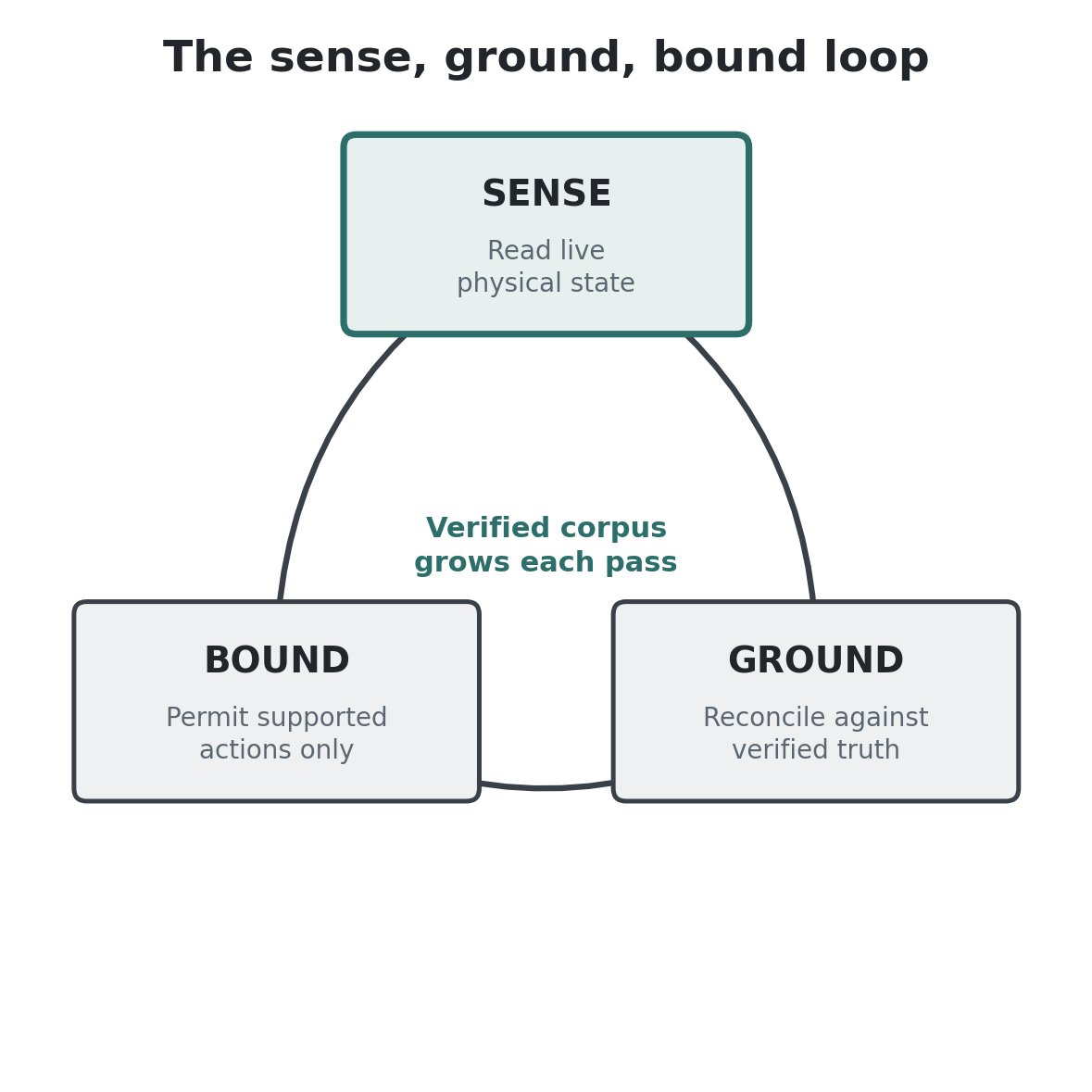
The loop converts buyable sensing into an asset that is not buyable: a verified record that grows with every pass.
That distinction is the heart of the matter, and it is where the commoditization argument breaks. Hardware gives you a raw strain or phase reading. It does not tell you that the transient on a given span was a contractor's boring machine rather than seasonal cable stretch. The causal link, the verified label, comes from a separate and unglamorous pipeline: correlating the signal with maintenance dispatch, field inspection, and network events until the root cause is confirmed. Industrializing that pipeline so it runs continuously and at scale takes trained crews, workflows that feed confirmation back into the record, and a habit of treating every unexplained signal as a labeling opportunity. A competitor can install identical instruments on the same day. It cannot instantly stand up the verification loop or inherit the years of reconciled observations, adjudicated discrepancies, false positives, and intervention outcomes already in the corpus. The hardware gap closes quickly. The time-series gap does not.
Synthetic data and digital twins narrow part of this gap, not all of it. A simulator reproduces the failure modes it was built to model, calibrated against events someone already confirmed. It cannot manufacture confirmed labels for the rare, idiosyncratic events that occurred on infrastructure it never instrumented, and that long tail is exactly what separates a mature corpus from a new one.
There is a second-order effect that strengthens the moat rather than bounding it. A verified label that ties a polarization signature on one span to a confirmed cause often transfers to spans that share a right of way, a soil type, or a construction vintage. The first operator applies that signature immediately to new routes. A late entrant, even on an identical neighboring fiber, has to rebuild the correlation from scratch because it lacks the confirmed labels to trust it.
Emerging work on shared-risk inference, including the IOWN Global Forum and ETSI F5G effort on co-cable detection, may make this kind of inference more systematic, but the evidence remains proof of concept. Even as the methods mature, standardization will make the loop easier to begin. It will not hand a late entrant the history it did not collect.
The practical moat, then, is not a proprietary sensor, a single algorithm, or a closed hardware architecture. It is the integration of observable technology with repeated operational adjudication. The published components are inputs. The corpus is the accumulated asset. The loop is the production system that keeps the asset current.
4. The silence is the signal
The disclosure asymmetry between telecom operators and hyperscalers is the clearest public signal that physical-layer intelligence is already treated as strategic.
Telecom operators tend to publish their network autonomy because, for them, autonomy is an efficiency story. It supports lower operating cost, faster assurance, better utilization, less manual intervention, and a clearer modernization roadmap. The incentives favor frameworks, reference architectures, proofs of concept, standards activity, and shared vocabulary.
ITU-T GSTR-ION-2030 is the strongest current anchor for that pattern. It is a framework, not a standard. It was agreed at the Study Group 15 plenary in Geneva in October 2025 and explicitly names chief technology officers among its intended audience. Its significance is not that the industry has finished the journey to autonomous networks. It is that telecom is willing to publish the journey at strategic level, because making the autonomy agenda visible helps align the capital and operating model required to pursue it.
Hyperscalers disclose differently. They publish substantial work on components. Google's optical circuit switching papers are examples, and publishing them supports research credibility, talent attraction, and ecosystem influence. A visible component can be described without disclosing the operating intelligence around it. What stays largely absent is equivalent public detail on physical-layer autonomy as an integrated system: how a hyperscaler continuously reconciles intended routes against observed physical paths, infers shared-risk dependencies, updates confidence in physical state, and decides which actions are safe under uncertainty.
Microsoft's September 2025 disclosure about added Azure latency marks the boundary precisely. The symptom was disclosed. The response system was not. The public learned that physical disruption affected service performance, not how the operator detected the dependency, reconstructed the relevant ground truth, bounded its remediation, or revised its internal model afterward.
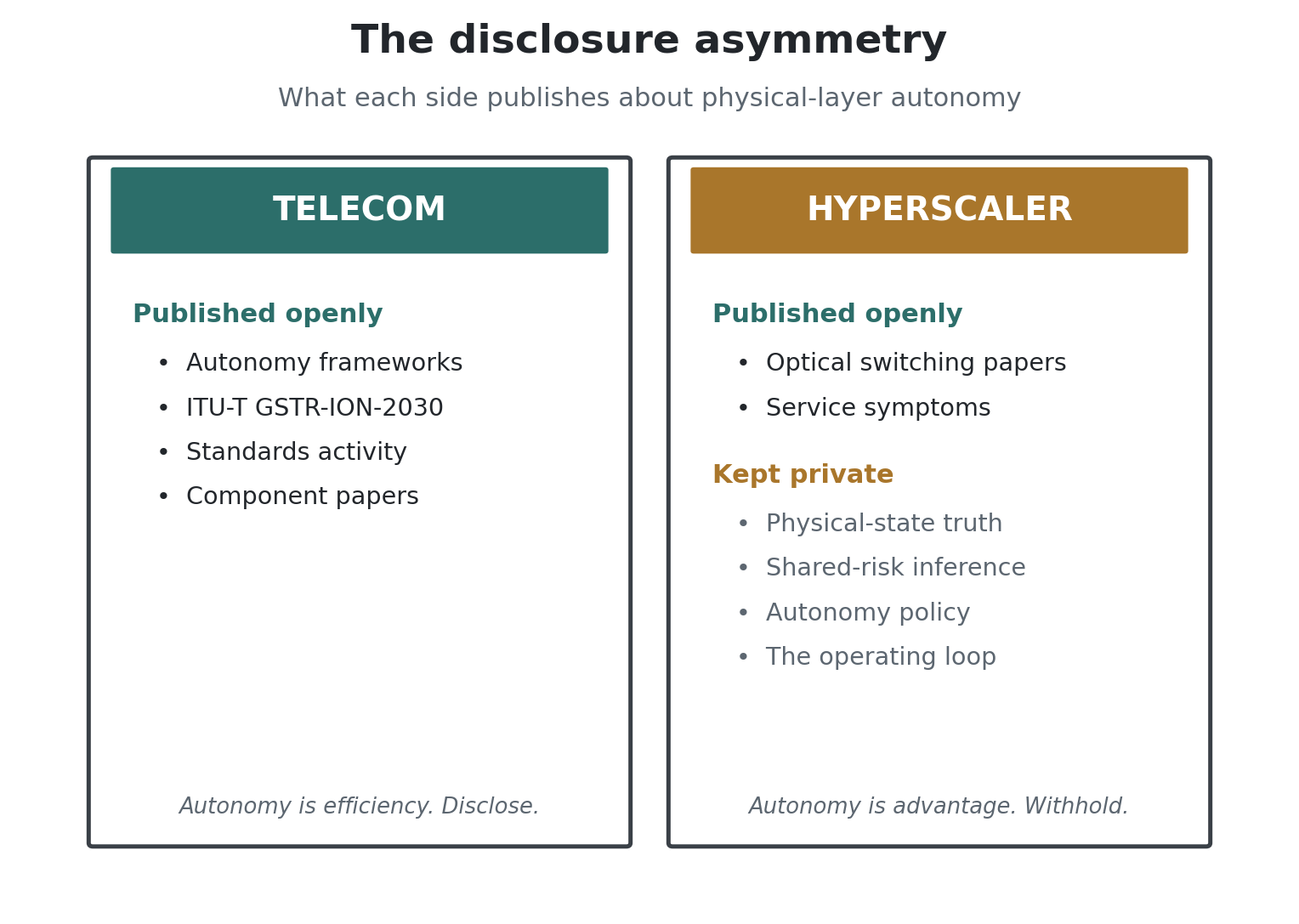
Telecom treats autonomy as efficiency and discloses it. Hyperscalers treat it as advantage and withhold the part that matters.
The inference has to stay disciplined, because silence has several innocent readings. Telecom operators face sector transparency expectations, standards commitments, and a commercial incentive to signal capability to wholesale customers and regulators, so part of their openness is structural rather than strategic. Hyperscalers operate under security review and competition-law constraints, may deliver the capability only as a managed service whose internals stay hidden, and in some cases may simply have less mature physical-layer autonomy to describe. Each of these explains part of the asymmetry, and none can be ruled out from the outside.
What they do not explain is the selectivity. The same companies publish their switching hardware in detail while staying quiet on the operating loop above it, and that pattern is harder to attribute to disclosure policy alone than to a judgment about which parts of the stack are safe to share. The asymmetry is therefore a signal to weight, not a fact to assert. Read conservatively, it suggests that the organizations with the most to gain from physical-layer intelligence have concluded the integrated corpus and loop should compound privately. It does not establish who is ahead, and this article does not claim to know.
5. Why the first verified corpus compounds
The first credible verified-ground-truth corpus compounds because every safe cycle improves the operator's ability to observe, decide, and act again, and the resulting advantage is one capital cannot reconstruct after the fact.
The mechanism is cumulative. Coverage produces observations. Observations create the chance to reconcile documentation with reality. Reconciliation produces verified ground truth. Verified ground truth permits carefully bounded autonomy. Autonomous actions generate new outcomes, which return to the corpus as evidence. Each cycle widens the usable context for the next.
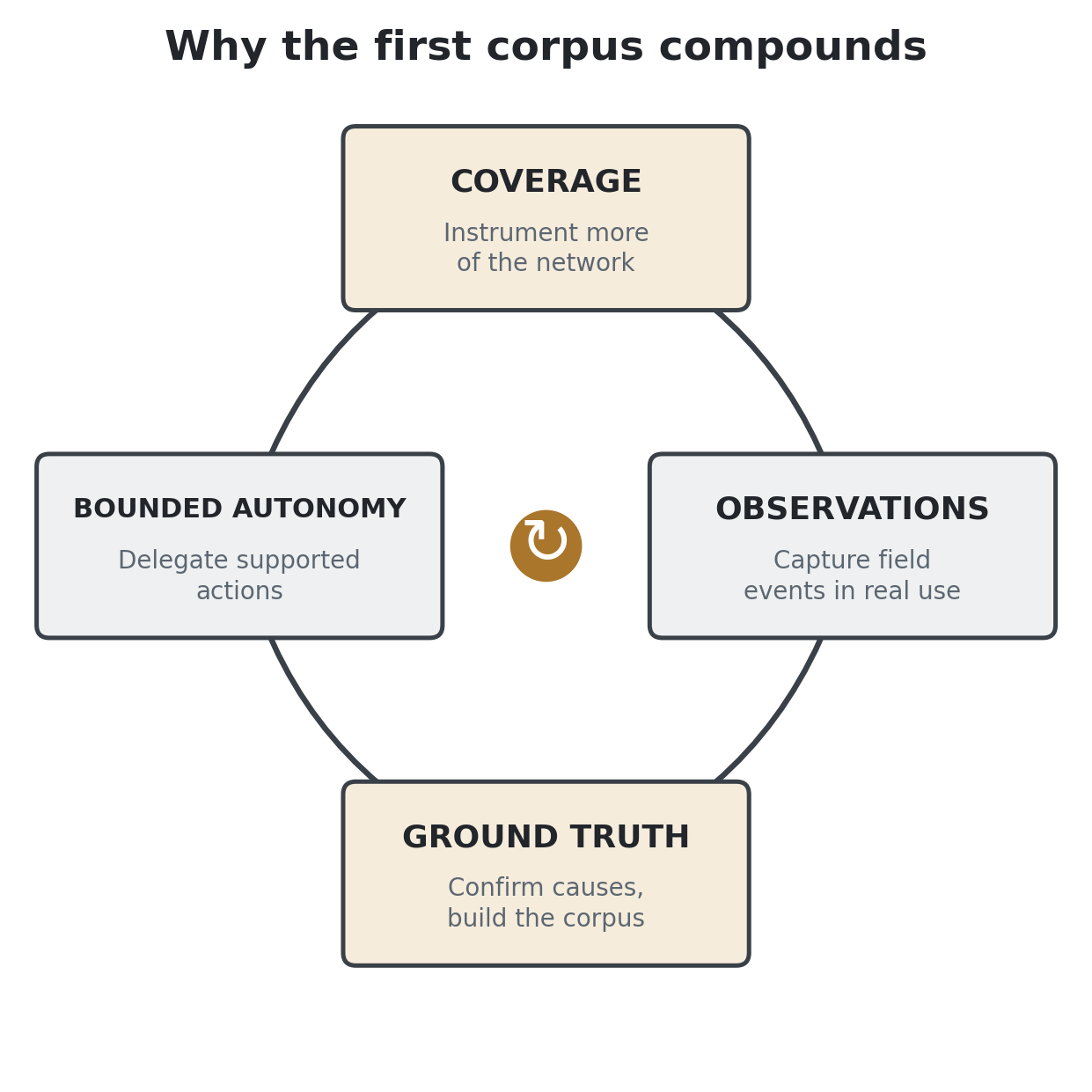
Each turn of the loop widens the next, which is why a late entrant cannot close the gap with capital alone.
The advantage is not simply more data. Raw telemetry can be abundant and strategically weak. The valuable corpus is adjudicated. It carries provenance, confidence, contradiction, resolution, and consequence. It separates what was recorded from what was observed, what was inferred from what was verified, and what was believed before an action from what was learned after it. Part of the corpus appreciates and part of it decays, and the distinction matters. Signatures tied to the physical environment, soil, water crossings, right-of-way geometry, seasonal stress, age slowly, because the physical world does not adapt to evade the operator. A frost-heave signature means roughly the same thing a decade later. Observations bound to a specific configuration, vendor, software version, or topology are perishable, and lose value as the network changes beneath them. A serious operator treats the corpus as a living asset, retiring stale configuration-bound records while compounding the durable environmental layer. That durable layer is the part a fraud model never has, because fraud evolves adversarially and ages out its own labels, and it is the part that compounds.
That structure changes the economics of autonomy. An operator with little verified history must keep broad classes of action behind human review. A mature corpus allows finer separation of familiar from novel conditions, reversible from irreversible actions, and high-confidence state from unresolved ambiguity. The result is not unrestricted autonomy. It is more precise permission.
This is where irreversibility-graded governance becomes commercially important. The strictest controls sit around actions whose physical consequences are hard or impossible to reverse. Lower-risk, observable, reversible actions run with lighter gates. The model expands autonomy where evidence supports it rather than applying the same friction to everything.
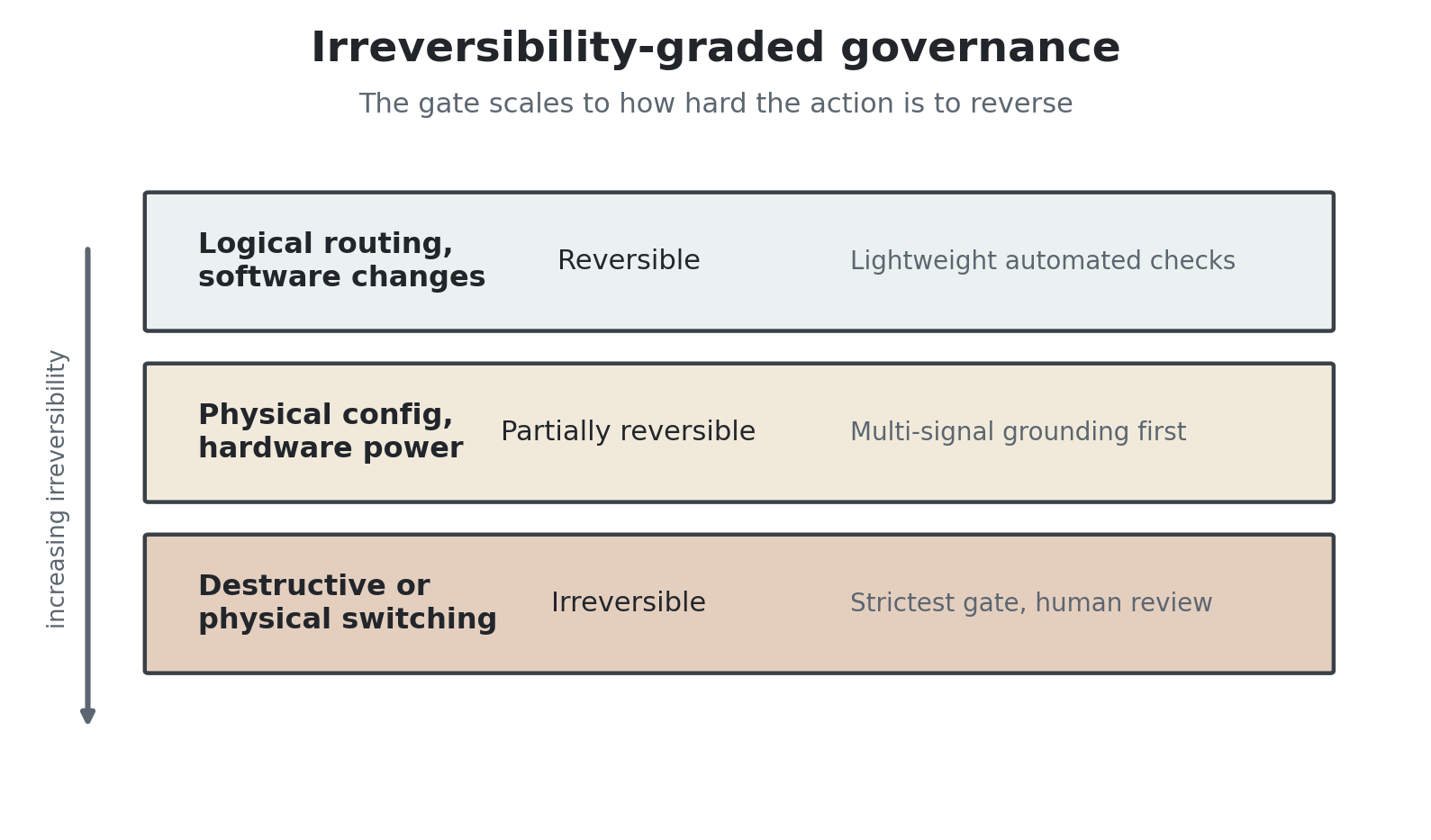
The gate scales to how hard the action is to reverse, so autonomy expands where the evidence supports it.
The DevOps Research and Assessment program, known as DORA and not to be confused with financial-sector resilience regulation, offers a tightly scoped analogy from software delivery: its research finds that blanket change-approval gates do not reduce failure and are associated with lower-performing delivery organizations. That evidence is about software delivery, not physical networks, and it should not be read as direct proof for infrastructure autonomy. It does support the design principle that universal approval is a poor substitute for risk-sensitive control. In practice the loop follows the quality of truth and the reversibility of the action. It begins in observation, comparing intended and observed state without controlling anything. It moves to recommendation, where people review proposed reconciliations and the system learns from the adjudication. Bounded execution follows only where the state is sufficiently verified, the action is reversible, and the outcome can be observed quickly. Irreversible physical actions are the last domain to earn autonomy, not the first.
The early-mover advantage follows from elapsed operating time. A late entrant can buy sensors, models, and consultants, deploy a modern architecture without legacy constraints, and even move faster in initial implementation. What it cannot buy is the missing sequence of observed winters, construction events, repairs, traffic shifts, equipment aging, maintenance windows, regional incidents, and physical interventions across its own network. Rare failure modes follow a long tail. The operator with the longer observation window has already seen precursors a fresh deployment will not encounter for years, and during those years it runs at higher availability on comparable routes. Capital can compress procurement. It cannot retroactively create observations.
The advantage strengthens once the corpus enters planning and commercial terms. Verified route exposure can shape resilience investment, capital prioritization, maintenance policy, and capacity placement. It also underwrites commitments. An operator that can show a historical record of detecting and localizing physical degradation before it became an outage can price reliability that a competitor without the record cannot credibly promise. The first operator to sustain the cycle does not merely automate sooner. It builds a private time series that becomes more expensive to challenge every year.
6. What could break this thesis
The intelligence-layer moat is real, but it is bounded by standardization, disclosure, corpus integrity, the immaturity of shared-risk inference, and a few commercial shortcuts.
Standardization narrows the entry gap. Published research already shows fiber working as a sensing substrate through acoustic and polarization methods. As equipment, methods, and interfaces mature, baseline observability gets easier to establish, and proprietary access to measurement loses value. The response is not to defend the sensor as the moat. It is to build the corpus, provenance model, adjudication practice, and operating loop that turn common sensing into differentiated intelligence.
Disclosure could be mandated. Physical infrastructure carries public-interest concerns, systemic dependencies, and resilience obligations. Regulation could require disclosure of route exposure, shared-risk relationships, or critical dependencies, partially socializing information that is private today. The defensible distinction is between shared safety facts and operator-specific operating intelligence. Even under stronger disclosure, the recency, confidence, and action history of an internal corpus can remain differentiated, though the moat would narrow.
The corpus is itself an attack surface. MITRE ATLAS documents adversarial tactics against machine-learning and agentic systems. A verified corpus cannot be treated as passive truth simply because it is central. A compromised process, a faulty instrument, or a manipulated source could corrupt the representation used to authorize action, and poisoning the ground-truth layer can influence many downstream decisions at once. The corpus has to be governed as critical infrastructure: rigorous provenance, versioning, separation of observation from inference, confidence tracking, independent corroboration, and constrained authority for any single source.
Shared physical dependency is still hard to prove. The IOWN Global Forum and ETSI F5G work on co-cable detection shows progress, but the evidence is proof of concept. An operator can hold abundant signals and still infer the wrong dependency, and false certainty about shared risk can be as dangerous as ignorance. The discipline is to preserve uncertainty explicitly, rank evidence through the Hierarchy of Truth, and never let inferred topology quietly become verified topology.
There are also commercial shortcuts that can transfer or erode the corpus. A competitor can acquire an operator that already runs the loop, converting an uncopyable asset into a purchasable one. Where sensing access is commercially open, a late entrant might lease capacity and observe its own traffic over another operator's instrumented infrastructure, partly sidestepping the requirement to have been there. The advantage also holds only where the early corpus is diverse. An operator that instrumented one benign route has thinner protection than a follower that targets richer, higher-hazard conditions. Depth of history matters less than density of informative events. And the corpus helps least where failure is sudden and unheralded. A clean cut from an anchor or a backhoe leaves few precursors to have learned from, so the advantage concentrates in gradual degradation rather than instantaneous loss.
A final risk is organizational. A corpus goes strategically slack if teams stop resolving contradictions or start mistaking consistent dashboards for truth. Ground truth has to stay revisable, provenance inspectable, and disagreement visible until resolved. The loop is valuable only while it keeps testing its own representation against the physical network.
None of these invalidate the thesis. They define its boundary. The moat is not permanent ownership of a secret sensing method. It is the sustained institutional ability to produce verified state faster, more credibly, and more usefully than competitors, while protecting the integrity of the process that produces it.
7. Build the loop now
The one layer that compounds through use and resists direct purchase is the verified-ground-truth layer.
The strategic stack is getting easier to read. Physical assets remain essential, models and automation diffuse, and sensing science is increasingly public. The differentiated asset forms when those components run continuously against a live network and become a trusted record of observed state, adjudicated discrepancy, bounded action, and measured consequence.
The disclosure asymmetry points the same way. Telecom publishes autonomy because the efficiency story benefits from visibility. Hyperscalers publish components and symptoms while revealing little about the integrated physical intelligence beneath autonomous operation. That silence names no winner. It does suggest that the organizations with the strongest reason to protect an infrastructure advantage have concluded the integrated corpus and loop should stay private.
For strategic operators, the implication is immediate. The program does not begin with a claim of full autonomy. It begins with the production of truth. Instrument the physical network. Compare intended state against observed state. Preserve contradiction. Record provenance. Resolve discrepancies. Track confidence. Bound actions by reversibility. Feed outcomes back into the corpus. The first useful milestone is not a self-driving network. It is a network that can explain which parts of its own representation deserve trust.
From there, autonomy becomes an earned operating right. Low-risk actions move first. Higher-consequence decisions follow as evidence accumulates. Physical actions that cannot be reversed stay under the strictest control. The system becomes more capable because it becomes more grounded, not merely more automated.
The competitive gap will show up as accumulated history. One operator will know that two routes labeled diverse repeatedly behave as one. Another will learn it during a failure. One will bound its actions with prior outcomes. Another will have a general approval gate standing in for knowledge. The advantage compounds quietly, through operating time, not through a single breakthrough. The market will not award this layer to the operator with the most sensors or the loudest autonomy narrative. It will accrue to the operator with the longest, most trusted record of physical reality, and the discipline to keep testing that record against the network itself.