Artificial Intelligence is predominantly designed, commercialized, and discussed as an off-site cloud technology. The dominant industry paradigm assumes a highly centralized footprint: hyperscale data centers, massive centralized training clusters, unconstrained power profiles, and high-bandwidth networks that require clients to maintain always-on connectivity to tap into machine intelligence. While this centralized model has successfully accelerated the initial wave of frontier model development, it structurally dictates who can access, afford, and benefit from these advancements.
For a significant portion of the global population, the infrastructure that determines the real-world utility of artificial intelligence will not begin in a hyperscale cloud data center. Instead, it must be engineered to operate within the infrastructure that already sits closest to the user: cellular towers, village Wi-Fi access networks, regional transport aggregation hubs, schools, clinics, and localized edge devices.
As generative workflows transition from passive content generation to active, autonomous tool execution, the traditional digital divide is fundamentally transforming. It is no longer defined merely by raw connectivity—the presence or absence of a data pipe. It has evolved into an intelligence access bottleneck. The division now stands between populations that can reliably leverage high-tier analytical models at low latency, and marginalized, geographically isolated communities that remain dependent on distant cloud infrastructure, expensive backhaul connectivity, and foreign platforms optimized for Western data profiles and high-resource languages.
Bridging this divide requires shifting from centralized cloud dependency to a distributed, multi-tiered infrastructure model. By transforming telecommunications networks from passive data-transit conduits into active edge inference grids, nations can build a resilient, context-aware foundation for sovereign intelligence at the last mile.
The Physical Reality: Vendor Landscapes and Proprietary Chokepoints
Any serious architectural framework for edge-hosted AI must directly confront the physical realities of the telecommunications landscape. The physical layer of global network infrastructure is highly consolidated, characterized by long capital depreciation cycles and deep vendor lock-in.
In emerging markets, particularly across the African continent, the Radio Access Network (RAN) layer is dominated by a select group of legacy providers:
┌────────────────────────────────────────────────────────────────────────┐
│                     AFRICAN TELECOM INFRASTRUCTURE                     │
├────────────────────────────────────────────────────────────────────────┤
│  ██████████████████████████████████████████████████░░░░░░░░░░░░░░░░░   │
│  Huawei Dominance (~70% of 4G/5G Core Networks)    Competitors         │
│                                                    (Ericsson, Nokia,   │
│                                                     ZTE, Samsung)      │
└────────────────────────────────────────────────────────────────────────┘
- Huawei: Serves as the primary infrastructure and cloud provider for dominant regional Mobile Network Operators (MNOs) like MTN Group and Vodacom, commanding an estimated 70% share of active 4G and 5G deployment footprints across Sub-Saharan Africa, and up to 80% in consolidated northern markets like Morocco.
- Ericsson: Acts as a vital strategic partner in highly competitive multi-vendor markets, offering high-performance baseband architectures that directly challenge legacy hardware footprints.
- Nokia: Retains a resilient infrastructure footprint across Southern and East Africa, with carriers frequently relying on its end-to-end 5G core and optical transport portfolios to diversify physical supply chain risks.
- ZTE: Functions as a highly competitive secondary vendor, securing substantial market share in large-scale fiber-optic deployments, national transport backbones, and public-sector data center rollouts in nations like South Africa and Ethiopia.
The fundamental engineering challenge is that legacy base stations are built on single-purpose Application-Specific Integrated Circuits (ASICs) housed inside proprietary Baseband Units (BBUs). These hardware configurations are hard-coded exclusively for Layer 1 and Layer 2 signal processing; they completely lack the general-purpose compute pipelines, vector-math accelerators, and memory architecture necessary to host local neural network processing.
A comprehensive "rip-and-replace" strategy to clear out these proprietary assets is commercially unviable. The path forward requires a pragmatic, software-abstracted integration strategy that co-exists with the dominant underlying vendor infrastructure.
The Economic Chokepoint: Total Cost of Ownership (TCO) at the Edge
Upgrading thousands of geographically dispersed, legacy cell towers into active compute nodes is an operational and financial challenge that cannot be reduced to the simple unit price of an AI accelerator. Operators must optimize the full Total Cost of Ownership (TCO) equation against harsh environmental and operational variables:
$$\text{TCO} = \text{CapEx}_{\text{(Silicon + Site Hardening)}} + \text{OpEx}_{\text{(Power + Cooling + Transport)}} + \text{System Integration Friction}$$
1. Structural Power and Thermal Overhead
Introducing discrete AI accelerators or high-density edge servers to an existing base station dramatically transforms the site’s energy profile. In low-connectivity and rural markets, energy is the single largest operational expense, accounting for up to 60% of a tower's total operating costs in off-grid or weak-grid environments. Many of these remote locations rely on localized diesel generators, solar-battery hybrid arrays, or fragile microgrids with zero power headroom. Adding a 75W to 300W acceleration layer requires substantial upgrades to local battery banks, solar surface areas, and passive cooling enclosures capable of surviving intense heat and dust without active, power-hungry air conditioning.
2. The Lifecycle Mismatch
The innovation loop of the semiconductor industry moves at blinding speed, with new AI chip architectures turning over every 18 to 24 months. Conversely, the capital expenditure models of telecommunications operators assume a 7-to-10-year depreciation runway for physical tower assets. If an operator deploys highly specialized, short-lifecycle accelerators across a vast geographic network, they face an extreme risk of asset obsolescence and stranded capital before the infrastructure pays for itself.
3. Utilization and Demand Volatility
Unlike centralized cloud environments where workloads can be dynamically aggregated from millions of concurrent users globally, a single tower site serves a localized, variable pool of users. If compute assets sit idle during off-peak hours, the cost per individual inference metric surges, undermining the financial sustainability of the deployment.
Strategic Mitigations: The AI-RAN and Phased Hub Framework
To navigate around these physical and economic constraints, operators can deploy a layered, three-tiered optimization model that blends open architecture with pragmatic workload placement:
                  ┌────────────────────────────────────────┐
                  │          NATIONAL / REGIONAL           │
                  │              CLOUD NODE                │
                  │   • Core Training & Global Context     │
                  │   • High-Density Centralized GPUs      │
                  └───────────────────┬────────────────────┘
                                      │
                         (High-Speed Backbone Fiber)
                                      │
                                      ▼
                  ┌────────────────────────────────────────┐
                  │       METRO / HUB AGGREGATION          │
                  │         (Top 5-20% of Sites)           │
                  │   • Shared Inference Cluster           │
                  │   • AI-RAN Containerized Workloads     │
                  └───────────────────┬────────────────────┘
                                      │
                       (Last-Mile Local Wi-Fi / RAN Link)
                                      │
                                      ▼
                  ┌────────────────────────────────────────┐
                  │         ON-DEVICE EDGE NODE            │
                  │   • 100% Offline Inference Localized   │
                  │   • Quantized Compact Model Runtime    │
                  └────────────────────────────────────────┘
A more graphic ideation below...
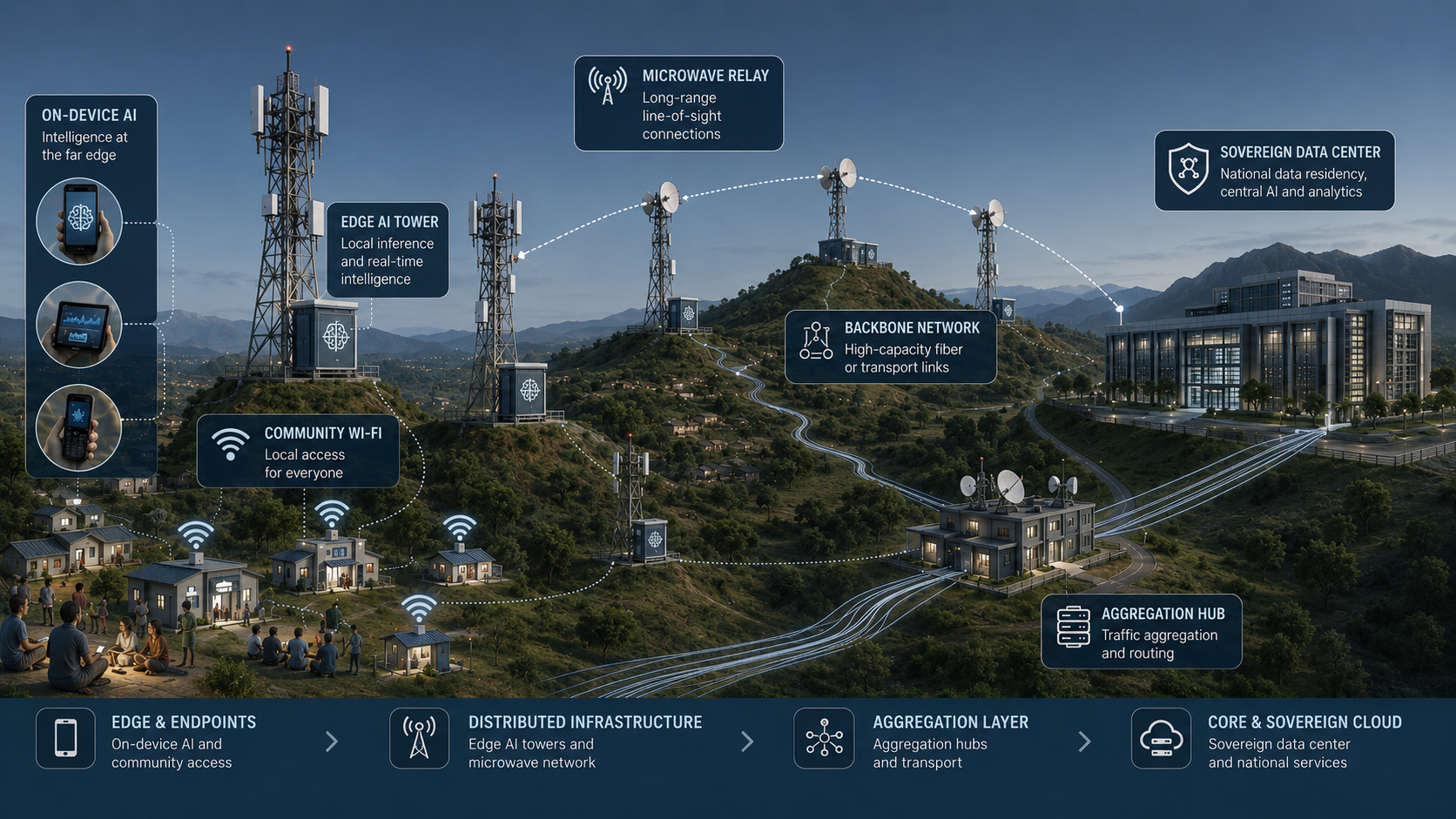
A distributed edge AI network architecture showing on-device intelligence, community Wi-Fi access, telecom towers with local inference, microwave relay stations for long-range transmission, aggregation hubs, backbone transport, and a sovereign data center. The image illustrates how intelligence can move closer to low-connectivity communities while preserving resilience, data sovereignty, and last-mile digital inclusion.
The 5% to 20% Hub Aggregation Strategy
Operators can completely avoid the financial penalty of a blanket tower rollout by focusing hardware upgrades strictly on key aggregation points: central offices, cable landing stations, major fiber intersection nodes, and dense metro-regional towers. By creating centralized mini-compute hubs that serve a 20-kilometer radius cluster of standard, legacy towers over high-speed microwave or fiber backhaul, the system achieves immediate scale and high asset utilization while shielding the most remote, power-constrained base stations from heavy hardware modifications.
Workload Convergence via AI-RAN
By shifting from fixed legacy hardware to open, software-defined network architectures, operators can execute cellular signal processing and edge AI inference on the exact same physical silicon fabric. Under an AI-RAN (Artificial Intelligence Radio Access Network) model, unified compute boards utilize high-performance host processors featuring integrated matrix-multiplication blocks.
This configuration enables dynamic resource allocation: during peak commuting hours, 90% of the local silicon capacity is dynamically dedicated to processing voice and cellular data packets. During off-peak nocturnal hours, the system shifts idle processing power to execute batch localized workloads, such as running agricultural diagnostic pipelines, updating public health models, or compiling localized translation databases. This structure drives hardware utilization to near-maximum, dramatically lowering the operational TCO.
Open RAN (O-RAN) Abstraction
By enforcing strict compliance with Open RAN standards, operators can break legacy vendor monopolies. Standardizing the interfaces between the physical hardware layer and the containerized software stack allows operators to deploy third-party edge applications without requiring custom integration from legacy equipment vendors like Ericsson or Huawei. Software guardrails and localized safety engines can interact directly with network orchestration loops through open APIs, rendering the entire architecture highly adaptable and vendor-agnostic.
Last-Mile Reach Architecture: Fiber Backbones and Shared Wi-Fi
The edge inference grid cannot rely on cell phones and cellular data plans alone. In marginalized geographies, individual mobile data costs are often prohibitively expensive relative to average household income, creating a secondary economic barrier to digital inclusion. To bypass this, national infrastructure strategies must tightly integrate core fiber backbones with open, community-shared access infrastructure.
When high-capacity national fiber backbones and middle-mile transport networks are deployed, they must be understood as more than mere data transmission lines to global internet exchange points. They function as the primary distribution highway for localized intelligence. These fiber rails connect the centralized regional data center hubs directly to localized edge access networks.
At the literal last mile, open Wi-Fi networks deployed across public institutions—including rural schools, regional healthcare clinics, local agricultural extension points, and municipal offices—become the primary access portals for local AI services.
By anchoring a local Wi-Fi access network directly to a GPU-enabled telecom aggregation hub, an entire community can interface with advanced diagnostic engines, multilingual administrative assistance platforms, and localized education systems natively. This model completely removes the requirement for individual cellular data transactions, delivering premium computing utility through public, shared digital infrastructure.
Data Sovereignty as an Active Production Vector
Data sovereignty is frequently reduced to a static legal compliance checkbox: enacting national data protection statutes, auditing storage locations, and dictating where a citizen's personal records physically reside. However, inside an AI-driven global economy, legal possession of raw data provides very little strategic agency if a nation remains entirely dependent on offshore infrastructure to transform that raw data into actionable intelligence.
True sovereignty is an active engineering output. If a nation continuously exports its unstructured internal data streams to foreign cloud regions to execute model inference, it enters a state of structural systemic dependency. The country loses visibility into the telemetry layer, exposes sensitive population characteristics to cross-border jurisdiction changes, and remains vulnerable to sudden network connectivity cutoffs or shifting international vendor policies.
Distributed edge inference architecture directly operationalizes data sovereignty through systematic data minimization:
- Localized Context Isolation: Raw data inputs—such as a patient's voice data during a clinical intake interview or detailed imagery of structural infrastructure damage—are completely processed and interpreted at the local node or client device level.
- Structured Metadata Synthesis: Instead of transmitting high-bandwidth raw files over international paths, the edge node distills the input down into a compact, highly compressed, and structured cryptographic metadata packet.
- Sovereign Synchronization: Only the non-identifiable, optimized metadata packet is synchronized back to national records, dramatically reducing international backhaul costs while maintaining complete structural compliance with localized data governance laws.
Software Execution Template: Edge-Tele
The deployment of a distributed infrastructure grid must be matched by a software architecture engineered to operate natively within zero-bandwidth environments. A premier functional blueprint for this paradigm is Edge-Tele: When the Network Fails, the Intelligence Stays, an offline incident copilot built by Ronald Mutebi for the Global Resilience category of the Gemma 4 Good Hackathon. Designed explicitly to serve field responders and community health workers operating in low-connectivity or disaster-impacted territories, Edge-Tele demonstrates exactly how to interface local users with decentralized intelligence systems.
Rather than defaulting to cloud dependencies that collapse during grid disruptions or severe weather events, Mutebi's architecture runs highly optimized, quantized models (such as the Gemma 4 E2B variant) directly on the physical mobile hardware carried by field operators. The system completely bypasses the data-transit bottleneck by processing multimodal field data—such as voice recordings, smartphone photography, and written text—entirely local to the client device.
By generating highly compressed, structured JSON sync packets, the local client records critical field observations deterministically. When proximity to a GPU-enabled telecom tower or a local Wi-Fi backbone network is restored, these packets automatically synchronize with the broader national network grid. Crucially, this architecture enforces linguistic equity. By utilizing deep on-device language models, Edge-Tele delivers automated triage instructions and processes field records across highly specific regional creoles—including Bislama, Tok Pisin, and Haitian Creole—dialects that mainstream cloud software routinely ignores or drops due to persistent network connectivity timeouts.
                  [ Multimodal Field Inputs ]
                  (Voice Notes / Imagery / Text)
                              │
                              ▼
                ┌────────────────────────────┐
                │    EDGE-TELE MOBILE CLIENT │
                │  Runs local quantized engine│
                │  (Gemma 4 E2B Framework)   │
                └─────────────┬──────────────┘
                              │
                   (Local SQLite Logging)
                              │
                              ▼
                ┌────────────────────────────┐
                │   COMPACT PACKET SYNTHESIS │
                │  Generates SHA-256 Hash    │
                │  & Cryptographic Nonce     │
                └─────────────┬──────────────┘
                              │
                    (Opportunistic Sync)
                              ▼
                ┌────────────────────────────┐
                │    DISTRIBUTED AI GRID     │
                │  (Local Telecom Wi-Fi Hub) │
                └────────────────────────────┘
Architected to run on memory-constrained client hardware without requiring active cloud network validation, Edge-Tele utilizes highly optimized, quantized architectures (such as the Gemma 4 E2B variant) optimized to operate entirely within 4GB of device RAM.
The software encapsulates the core tenets of last-mile design:
- Zero-Connectivity Autonomy: The application treats the device as an isolated, self-contained computing environment. It ingests voice dictation, analyzes imagery of structural incidents, maps coordinates, and references localized crisis playbooks completely in airplane mode.
- Linguistic and Dialectal Inclusivity: Rather than defaulting to general-purpose cloud translation APIs that automatically fail during network drops, Edge-Tele runs local language processing configurations. This enables high-fidelity localized operations across creoles and regional dialects—including Bislama, Tok Pisin, and Haitian Creole—ensuring marginalized communities receive clear guidance in their primary spoken languages.
- Cryptographic Audit Chains: To prevent data tampering or silent file corruption during extended offline periods, every single recommended support action and localized user override is logged sequentially into a local database. The engine appends each entry with a distinct timestamp, cryptographic nonce, and a SHA-256 hash linked directly to the prior entry, creating an immutable audit chain that can be independently verified the millisecond the device establishes a link to the nearest telecom edge hub.
Conclusion: The Architecture of an Inclusive Utility
The democratization of machine intelligence will not be achieved by incrementally scaling the parameter counts of distant, cloud-hosted frontier models. Real-world accessibility depends on transforming the physical layer of the network itself.
By matching localized, edge-native software models like Edge-Tele with a pragmatic, phased transition toward an AI-RAN telecom infrastructure fabric, countries can systematically build a defensible, highly resilient national utility. This integrated approach ensures that the transformative compute capacity of tomorrow is insulated against physical network infrastructure disruptions, financially optimized against capital obsolescence, and anchored within a firm framework of localized sovereign control.